
WorkMark › HVAC inspection checklist
Free · No email requiredHVAC inspection checklist
This is the 52-point checklist WorkMark ships with, and every item comes with the standard it is measured against. It is built for residential cooling and heat-pump systems. Print it, download the PDF, or run it on a phone and give the homeowner a report instead of a carbon copy.
PDF · US Letter · one form per system · no email, no form
52 points · residential cooling & heat pump · one sheet per system
| Customer | Service address | Date | Technician |
| System # / location | Outdoor unit — make & model | Serial | Refrigerant |
| Work order # | Indoor unit — make & model | Serial | System age |
G Good · A Average · P Poor · M Missing (not present) · write readings and findings in the last column
How to use it
- One checklist per system. A house with an upstairs and a downstairs unit gets two.
- Rate every item Good, Average, Poor or Missing. Missing means the part is not there — a surge protector that was never fitted, a float switch nobody installed.
- Where an item asks for a reading, write the number down. A reading is what makes a finding more than an opinion.
- Finish with an overall rating — Good, Fair, Poor or Critical — and what you recommend.
They are WorkMark’s defaults — the ones a working HVAC company uses on its own tune-ups. Where the manufacturer’s installation instructions or local code say something different, those win.
Gas furnaces. This is a cooling and heat-pump checklist; heat exchanger, burners, flame sensor and limit switches belong on a heating checklist.
The checklist
Outdoor Unit (Condenser) 12 items
| # | Item | Standard | G | A | P | M | Reading / notes |
|---|---|---|---|---|---|---|---|
| 1 | Condenser coil – cleanliness & fin condition | Fins straight, no debris | |||||
| 2 | Condenser coil – refrigerant leak check | UV dye / electronic detector | |||||
| 3 | Condenser fan motor – operation & amperage | Within the nameplate rating | |||||
| 4 | Condenser fan blade – cracks, balance, clearance | No wobble; min. 1" clearance | |||||
| 5 | Compressor – start/run amperage (RLA/LRA)Reading | Within ±10% of nameplate | |||||
| 6 | Compressor – sound & vibration | No clicking / grinding | |||||
| 7 | Capacitor – run & start (µF reading)Reading | Within ±6% of rating | |||||
| 8 | Contactor – pitting, burning, pull-in | Contacts flat; coil ≤ 24V | |||||
| 9 | Disconnect / fuses – rating & condition | Correct amp rating; no corrosion | |||||
| 10 | Electrical connections – tightness & insulation | Terminals tight; insulation intact | |||||
| 11 | Refrigerant lines – insulation & support | No gaps; secure every 6 ft | |||||
| 12 | Unit pad / mounting – level & secure | ≤ ½" out of level |
Indoor Unit (Air Handler) 11 items
| # | Item | Standard | G | A | P | M | Reading / notes |
|---|---|---|---|---|---|---|---|
| 13 | Evaporator coil – cleanliness & frost check | No ice; fins clean | |||||
| 14 | Evaporator coil – refrigerant leak check | UV / electronic detector | |||||
| 15 | Blower wheel – cleanliness & balance | No buildup; no wobble | |||||
| 16 | Blower motor – amperage & RPMReading | Within the nameplate rating | |||||
| 17 | Air filter – type, size, condition | Replace if ≥ 50% loaded | |||||
| 18 | Primary drain line – flow & slope | Free flow; min. ¼"/ft slope | |||||
| 19 | Secondary drain / safety switch | Float switch activates properly | |||||
| 20 | Condensate drain pan – cleanliness | No algae, cracks, or standing water | |||||
| 21 | Electrical connections – tightness | All terminals tight | |||||
| 22 | Plenum / cabinet – leaks & insulation | Sealed and insulated; no air leaks | |||||
| 23 | UV / air-purification accessories | Lamp operational; bulb age noted |
Refrigerant System & Performance 9 items
| # | Item | Standard | G | A | P | M | Reading / notes |
|---|---|---|---|---|---|---|---|
| 24 | Refrigerant charge status | Charged to the manufacturer's specification | |||||
| 25 | Suction line temperature (°F)Reading | Measured at the unit | |||||
| 26 | Discharge line temperature (°F)Reading | Measured at the unit | |||||
| 27 | Suction pressure (psig)Reading | Measured at the unit | |||||
| 28 | Discharge / head pressure (psig)Reading | Measured at the unit | |||||
| 29 | Superheat (°F)Reading | TXV: 8–12°F / Fixed: per chart | |||||
| 30 | Subcooling (°F)Reading | Target: 10–15°F | |||||
| 31 | Delta-T supply vs. return (°F)Reading | Target: 14–22°F split | |||||
| 32 | Metering device – TXV stability | Stable superheat; no hunting |
Electrical & Controls 9 items
| # | Item | Standard | G | A | P | M | Reading / notes |
|---|---|---|---|---|---|---|---|
| 33 | Supply voltage at unit (VAC)Reading | ±10% of nameplate | |||||
| 34 | Thermostat – calibration & operation | ±1°F accuracy; all modes tested | |||||
| 35 | Thermostat – wiring connections | All terminals tight | |||||
| 36 | Thermostat – battery / display | Replace if < 20% | |||||
| 37 | Low-voltage wiring – condition & routing | No chafing; proper gauge | |||||
| 38 | Surge protection device | Fitted at the unit; status light green | |||||
| 39 | GFCI / disconnect – proper operation | Trips and resets correctly | |||||
| 40 | Safety controls – high & low pressure | Cut-out set points correct | |||||
| 41 | Reversing valve — heat pump systems | Smooth changeover between heating and cooling; no bypass |
Ductwork & Airflow 6 items
| # | Item | Standard | G | A | P | M | Reading / notes |
|---|---|---|---|---|---|---|---|
| 42 | Supply & return duct – insulation condition | R-6 min. in unconditioned space | |||||
| 43 | Duct connections – leakage at joints | Mastic or metal tape; no duct tape | |||||
| 44 | Return air – size adequate for system | Sized for the system's airflow | |||||
| 45 | Supply registers / grilles – cleanliness | No blockage; proper airflow direction | |||||
| 46 | Duct routing – kinks or restrictions | Flex duct < 4 ft; no sharp bends | |||||
| 47 | Air balancing – room-to-room comfort | Even temperatures room to room |
Safety & Environmental 5 items
| # | Item | Standard | G | A | P | M | Reading / notes |
|---|---|---|---|---|---|---|---|
| 48 | Carbon monoxide check (near air handler)Reading | < 9 ppm ambient | |||||
| 49 | Electrical panel / breaker – rated | Correct breaker size | |||||
| 50 | Clearances – combustibles around unit | Min. 18" all sides | |||||
| 51 | Condensate overflow – flood protection | Float switch or secondary drain | |||||
| 52 | UV exposure – outdoor wiring / insulation | No cracking from sun damage |
WorkMark — free HVAC inspection checklist · workmark.app/hvac-inspection-checklist · Standards are defaults; the manufacturer’s instructions and local code take precedence.
Inspection or tune-up?
A tune-up is the work: cleaning the coil, tightening the terminals, clearing the drain, checking the charge. An inspection is the record of what you found while doing it — every component rated, every reading written down.
A tune-up without the record leaves the homeowner with a receipt and a sticker on the unit. With it, they know what is wearing out before it fails, and you have something to show them on the next visit.
What the homeowner should get
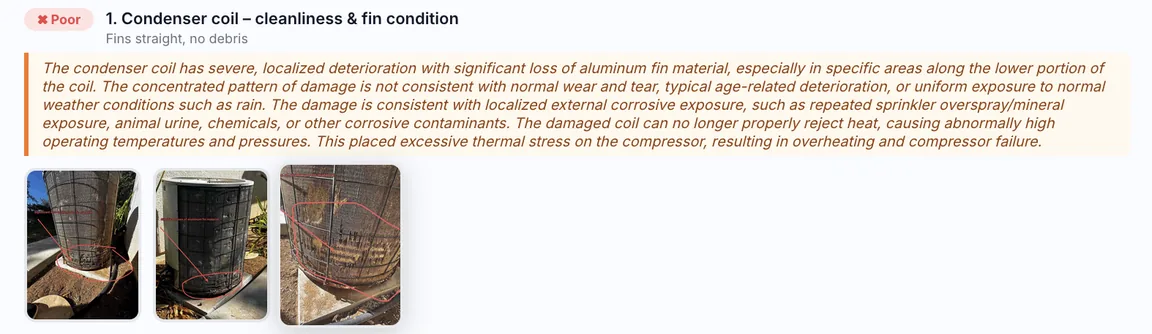
The checklist is for the technician. The homeowner needs something else: what you found, how serious it is, what it looks like, and what fixing it costs.
- Every system rated — Good, Fair, Poor or Critical
- Each finding in plain words, next to the standard it was measured against
- Photos of the problem, with an arrow on it
- The readings that matter
- The options — repair it or replace it — with a price on each
Run it on a phone instead
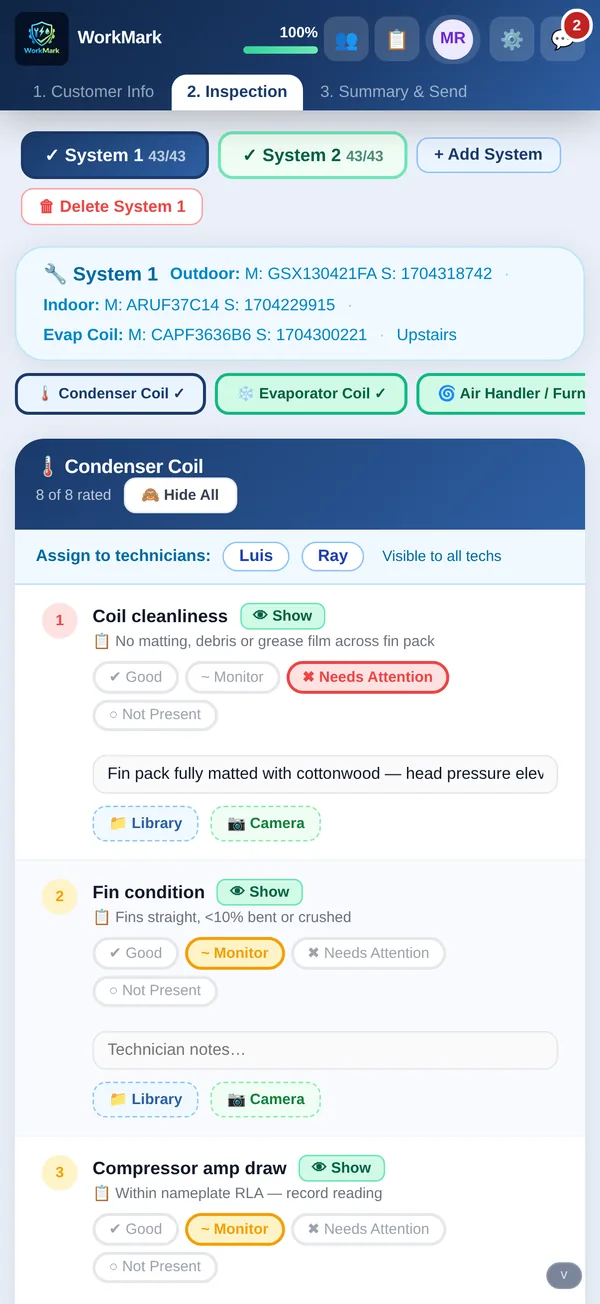
This checklist is what WorkMark opens with on every new inspection — the same 52 items, the same standards. On a phone it does three things paper cannot:
- Photos on any item, marked up on the spot — arrows, circles, text.
- Findings turn into quote lines. A failing capacitor becomes a capacitor replacement on the quote; a missing surge protector becomes an installation. Nobody retypes it.
- The homeowner gets a link, not a carbon copy. You send it from your phone by email or text. They open the report, compare repairing against replacing, and choose — and you are notified when they do.
Every line stays yours to change: reword an item, change a standard, hide one from the homeowner’s report, or import your own form from Excel.
Card required, nothing charged until day 15, cancel any time before then.
Questions
Is the PDF really free?
Yes. No email, no form, no trial required. Print as many copies as you need and use them in your shop.
How often should an air conditioner be inspected?
Once a year, before the cooling season. ENERGY STAR recommends pre-season check-ups — the cooling system in the spring, the heating system in the fall. A system that already has a Poor finding is worth seeing again sooner.
What superheat and subcooling should I see?
The checklist uses common targets: 8–12°F superheat on a TXV system, 10–15°F subcooling, and a 14–22°F temperature split across the evaporator coil. Fixed-orifice systems take their superheat from the manufacturer’s charging chart. These are where to start, not the spec — always charge to the manufacturer’s specification.
Does this checklist cover gas furnaces?
No. It is built for cooling and heat-pump systems — the AC tune-up. A gas furnace needs its own checks: heat exchanger, burners and ignition, flame sensor, limit switches, venting. The checklist in WorkMark is editable, so you can add them.
What is the difference between Poor and Missing?
Poor means the part is there and failing — a pitted contactor, a capacitor below its rating. Missing means it is not there at all — no surge protector, no float switch. The difference shows up on the quote: Poor is usually a repair or a replacement part, Missing is usually something to install.
Can I change the checklist?
On paper, write in the margins. In WorkMark every line is yours: the wording, the standard, the order. You can hide an item from the homeowner’s report, and import your existing tune-up form from an Excel file.
Try it on your next tune-up
Run this checklist on a phone, send the report from the driveway, and see what the homeowner does with it.